

HDFC Life’s individual WRP grew 16% year on year in October, the fastest among listed private peers. Yet IRDAI’s draft on distribution costs is unresolved, and the stock sits 24.3% below its 52-week high. This HDFC Life share price analysis weighs both. At ₹596.30 on 12 November 2026, the StockPrompt.ai model scores the stock 57/100 and reads it as neutral to sideways. The verdict: the long-term thesis is intact, but a 63x P/E leaves little reward at today’s price.
Q2 FY27 results: VNB outgrows APE
Value of new business grew faster than premium in H1 FY27, and the margin widened. VNB rose 12.1% to ₹2,037 Cr at a 24.7% margin, with Q2 VNB growth at 14.8%. APE grew about 11% in the half, so VNB grew ahead of it.
Q2 profit after tax was ₹522 Cr, up 16.4% year on year, on revenue growth of 18.3%. Individual WRP grew 11% against 10% for the private industry. For wider earnings coverage beyond these HDFC Life Q2 FY27 results, see our quarterly results blog.
| H1 FY27 metric | Value |
|---|---|
| Value of new business (VNB) | ₹2,037 Cr (+12.1%) |
| New business margin | 24.7% |
| Embedded value (EV) | ₹66,461 Cr |
| Operating RoEV | 14.9% |
| Solvency | 180% |
| Profit after tax | ₹1,119 Cr (+12.7%) |
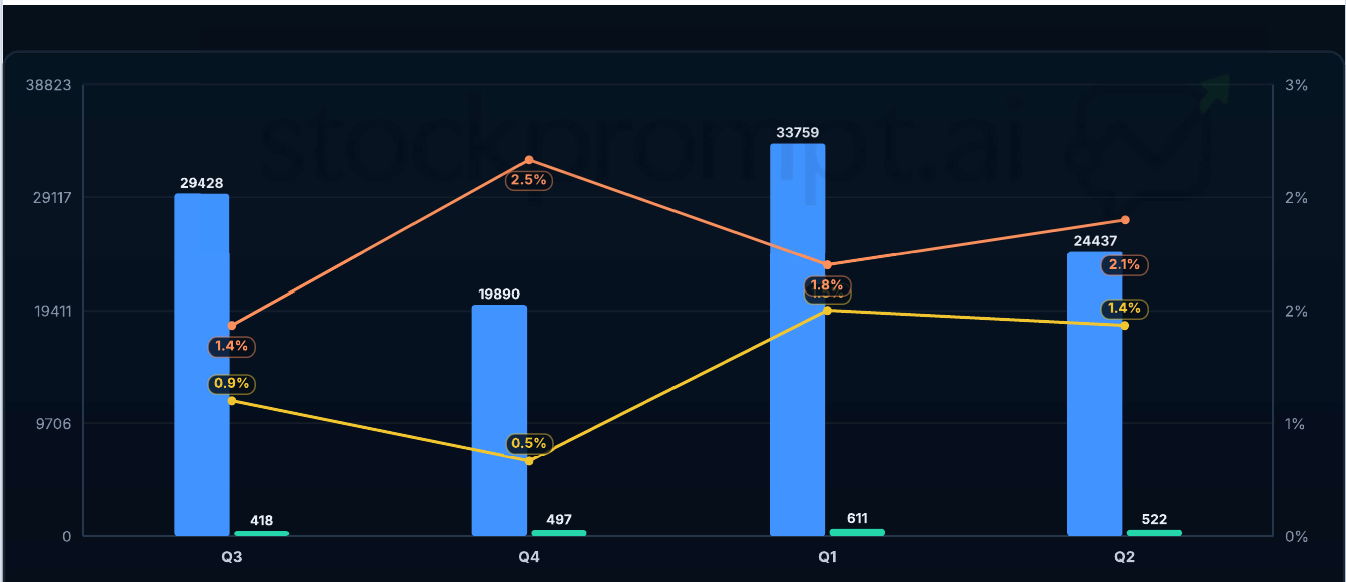
Quarterly revenue and PAT. Profit is lumpy: ₹418 Cr in Q3 FY26, ₹611 Cr in Q1 and ₹522 Cr in Q2 FY27. The margin lines are of limited use for a life insurer.
Growth drivers: penetration, GST and channels
Under-penetration is the long-run driver. An industry CEO said “Insurance for All by 2047” needs policy counts to grow about 7–8% a year for two decades. The GST exemption on individual life and health policies, effective 22 September 2025, lifted ticket sizes 10–15%, per Policybazaar.
Industry first-year premium rose 20.6% to ₹2.46 lakh Cr in H1 FY27, and October new business premium rose 26.2% to ₹42,914 Cr. Mix is shifting toward annuity (12% of H1 individual APE) and retail protection (8% of APE, up 33%).
Distribution is broad. HDFC Bank supplied about 48% of H1 APE, while agency APE grew 13%. See our HDFC Bank share price analysis for the banca anchor.
| Franchise metric | Mar 2023 | Mar 2026 |
|---|---|---|
| Individual APE | ₹11,401 Cr | ₹14,635 Cr |
| Agents / consultants | 179.4K | 272.0K |
| Branches | 498 | 715 |
| ULIP share of individual APE | 19% | 44% |
| 13th-month persistency | 87.0% | 85.0% |
| 61st-month persistency | 52.0% | 64.0% |
Caveat: October individual WRP growth for the industry slowed to 5%, partly on a high base from the GST rush. The 26% headline is flattered by LIC and group or single premiums.
The biggest weakness: IRDAI’s distribution rules
IRDAI’s draft on distribution costs is the largest unresolved risk, and the analysis rates it the most severe. It proposes expense limits (EoM) of 15% within two years and 12.5% within five, plus commission caps and credit-life limits. HDFC Life’s expense ratio is about 21%.
Credit-life commission could fall from 28% to 2%. Management says agency would be least affected, and brokers and corporate agents most. This is still a consultation: the comments deadline moved from 25 to 31 October 2026, insurers are lobbying for a longer glide path, and the proposed start date is 1 April 2027.
Persistency adds pressure. 13th-month persistency fell from 85.0% in March 2026 to 83% in H1 FY27 on weaker ULIP renewals and a specific non-par cohort. Management expects some recovery by year-end, and the model trimmed the composite score by 2 points for both issues.
Valuation against peers
Our HDFC Life share price analysis treats 63x earnings as fairly valued at best, with price-to-EV the better lens. P/E is 63.03x, P/B is 6.09x and PEG is 4.88, giving a valuation score of 35/100. Price-to-EV is 1.95x on H1 FY27 EV, and about 1.53–1.56x on FY28E EV per share (₹383–389 per brokerage models).
As an illustration, not a forecast: if EV compounds at 14.9% for three years, it reaches about ₹1.01 lakh Cr, and today’s market cap would be 1.28x that EV. At 12% growth the figure is 1.39x.
| Metric | HDFC Life | Peer median | Gap |
|---|---|---|---|
| P/E | 63.1x | 60.6x | +4% |
| Quarterly profit growth | +16.4% | 20.0% | Rank 4 of 6 |
HDFC Life’s P/E sits close to the industry’s 63.8x and below SBI Life’s 68.5x, but well above ICICI Life (38.5x) and LIC (8.2x). Quality ranks third of six and size third. Compare a listed peer in our SBI Life share price analysis. Brokerage fair-value estimates sit above the price but are outside the model score.
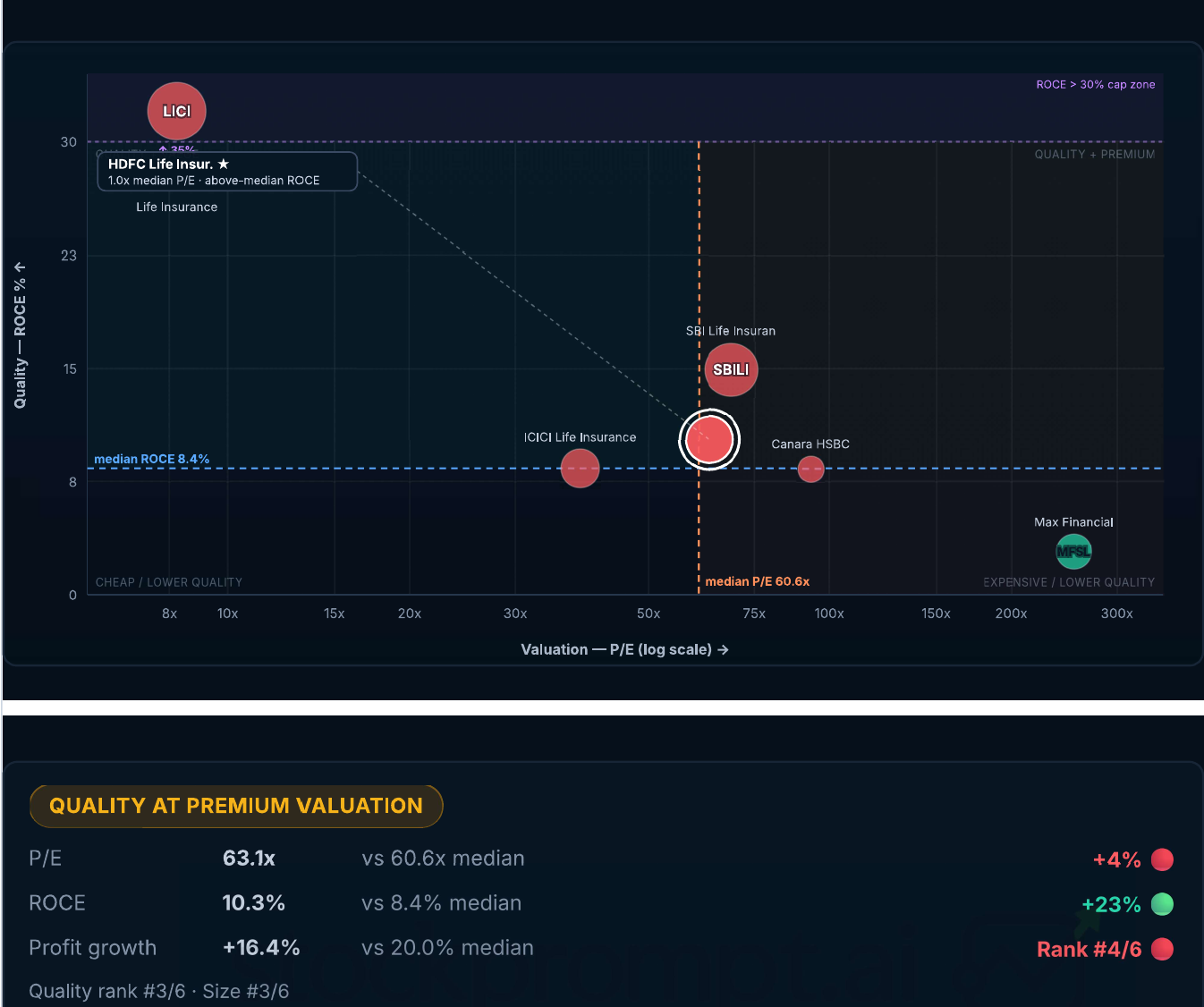
Peer positioning: valuation (P/E, log scale) against ROCE, with bubble size showing market cap. ROCE is a weak yardstick for insurers.
Technical view and model levels
The chart has turned up sharply, but model reward-to-risk at ₹596.30 is only 0.10x. This HDFCLIFE technical analysis shows a 3.97% gain (+₹22.75) on 12 November from ₹573.55, on volume of 4.46M. The stock is 24.3% below its 52-week high of ₹787.55.
MACD is bullish, ADX is 22.65 (ranging) and the price is above the upper Bollinger Band of ₹585.35. RSI is 66.7 in the summary and 73.95 on the chart, which is overbought. The 126-day return trails the benchmark by 11.4%, and the technicals score is 65/100.
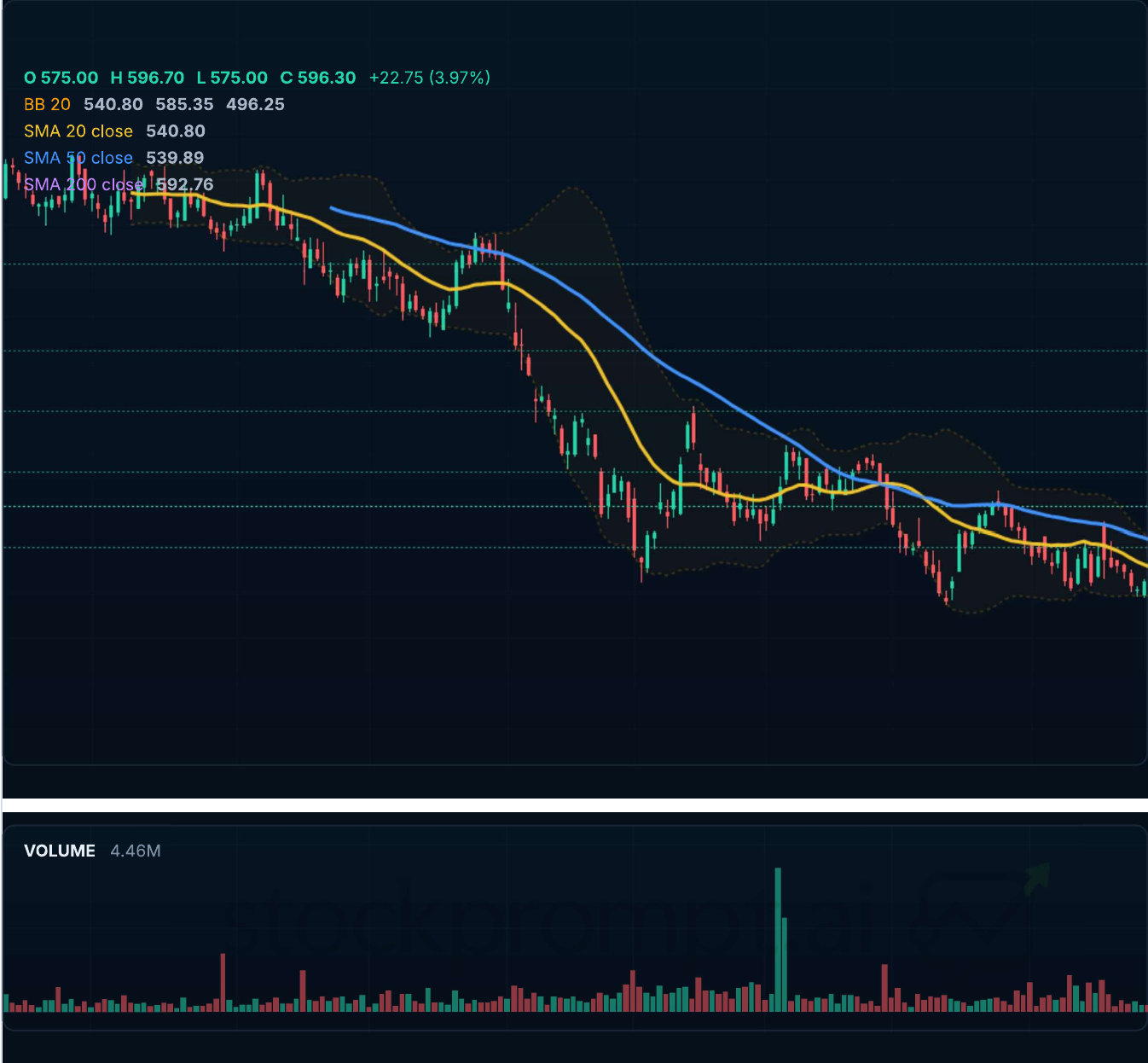
Daily candles with moving averages, Bollinger Bands and volume (12 November 2026).
Model levels for education (not advice). Tactical horizon 2–4 months; the long-term thesis runs 3–5 years.
| Model level | Value | Note |
|---|---|---|
| Favourable zone | ₹579.43 – ₹590.68 | Price is just above it |
| Upside levels | ₹614.04 / ₹704.93 | Base / bull; 61.8% Fibonacci at ₹618.25 |
| Downside references | ₹525.21 / ₹417.53 | Parabolic SAR (bullish) / risk level (bear case) |
| Risk-reward at ₹596.30 | 0.10x base, 0.61x bull | 0.17x / 0.72x near the favourable zone |
Risks and what to watch
Beyond regulation and persistency, the analysis flags three further risks:
- Valuation: a de-rating if VNB growth disappoints.
- Investment variance: equity returns of 3–3.5% against 5% expected, plus wider credit spreads, hit the EV walk.
- Product mix: a ULIP share of 44–45% makes growth sensitive to markets.
No company-specific legal or regulatory action was found. Exide Life M&A is a stated priority, but its approval status could not be confirmed.
What to watch next:
- IRDAI’s final rules, with a proposed start of 1 April 2027.
- VNB growth against APE growth, and whether the margin holds at 24–25%.
- Persistency recovery, HDFC Bank’s counter share and agency productivity.
- Solvency of 180%, which includes a ₹500 Cr subordinated debt raise adding about 4 points.
- Monthly industry WRP data once the GST base effect fades.
Ownership as of Jun 2026: promoters hold 50.54% (+0.33 pp), FIIs 19.27% (−3.25 pp) and DIIs 20.19% (+2.94 pp). Pledge is 0%.
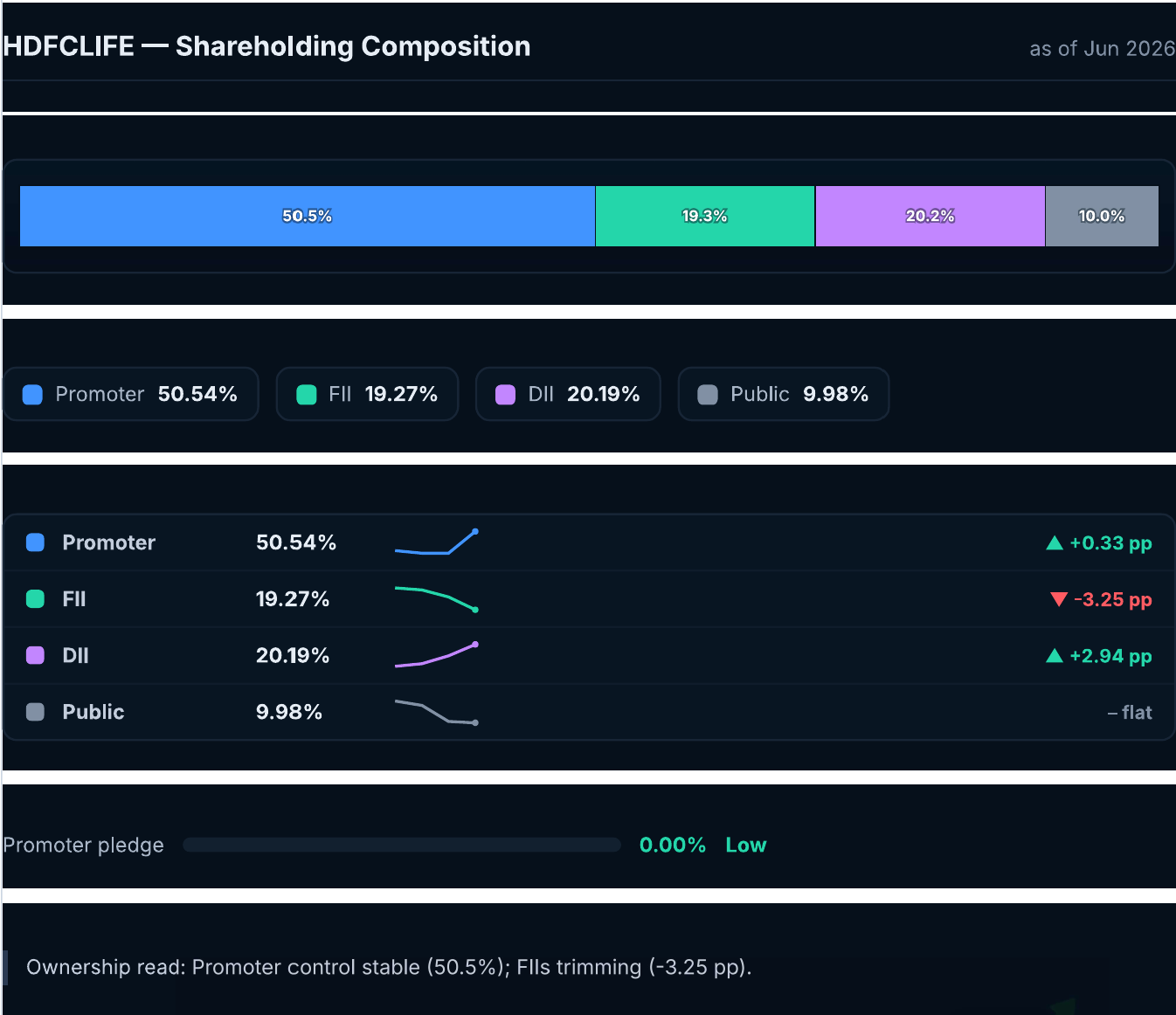
Shareholding composition as of Jun 2026, with change versus the prior quarter.
Conclusion
Strip away the daily moves and HDFC Life rests on two questions: will penetration keep deepening, and will the final rulebook stay benign? The composite score is 57/100: fundamentals 68, institutional 68, risk 67, technicals 65 and valuation 35. The near-term score is 60, with a neutral bias.
Want to test how the IRDAI outcome could change VNB margin? Run your own HDFC Life share price analysis on StockPrompt.ai, see the research features, or get started in minutes.
Try This on StockPrompt.ai
HDFC Life Stock Analysis 2026: Can Insurance Penetration Drive Long-Term Growth?
Frequently Asked Questions
Is HDFC Life overvalued at 63x earnings?
The model scores valuation a weak 35/100: P/E is 63.03x, P/B is 6.09x and PEG is 4.88. On price-to-EV, the better insurer lens, it trades at 1.95x H1 FY27 EV, and the model status is “fairly valued”.
What is HDFC Life’s VNB margin?
The new business margin was 24.7% in H1 FY27, on VNB of ₹2,037 Cr, up 12.1%. VNB grew ahead of APE, at 12% against 11%.
Which IRDAI proposal could affect HDFC Life?
IRDAI’s draft proposes expense limits of 15% within two years and 12.5% within five, plus commission caps, from 1 April 2027. HDFC Life’s expense ratio is about 21%, and the draft remains a consultation.
Disclaimer: This is AI-generated analysis for educational purposes only. AI can make mistakes, so always verify data independently. Model levels are for education and are not recommendations. This is not SEBI-registered investment advice. Please consult a SEBI-registered advisor before making investment decisions.
Sources: Company filings and Q2 FY27 earnings call, brokerage result updates, Life Insurance Council and IRDAI data, and company and peer financials, as compiled in the StockPrompt.ai analysis dated 12 November 2026.